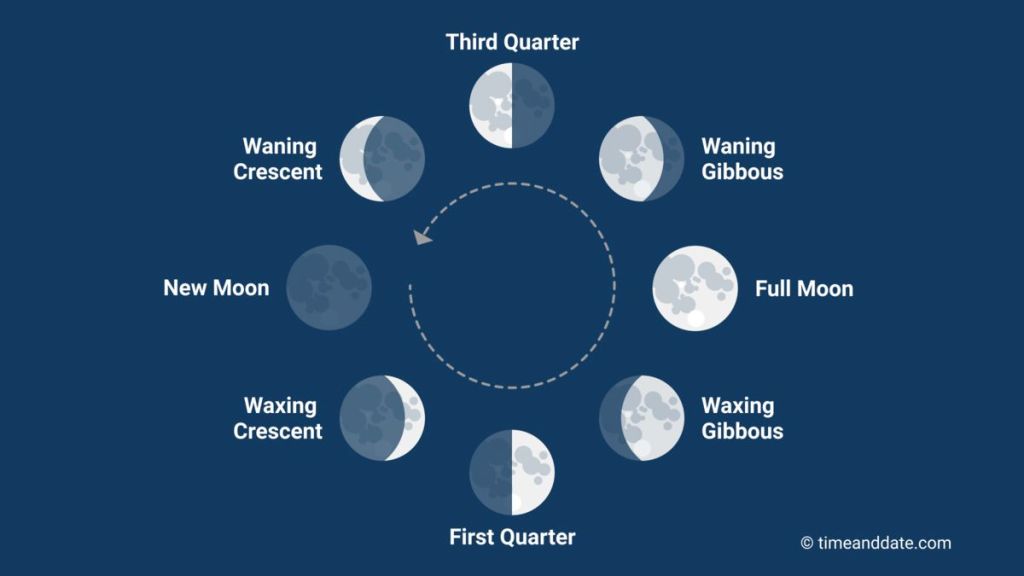
A lunar month starts at the invisible New Moon and lasts through all the Moon phases until the next New Moon.
Phases of the Moon
Half of the Moon’s surface is always illuminated by sunlight. As the Moon orbits Earth, it changes how much of the lit-up side we can see. This is known as a Moon phase. Primary Moon phases happen at a specific moment in time, while the time between these moments are intermediate Moon phases.
The primary phases are New Moon, First Quarter Moon, Full Moon, and Third Quarter Moon.
The intermediate Moon phases are Waxing Crescent Moon, Waxing Gibbous Moon, Waning Gibbous Moon, and Waning Crescent Moon.
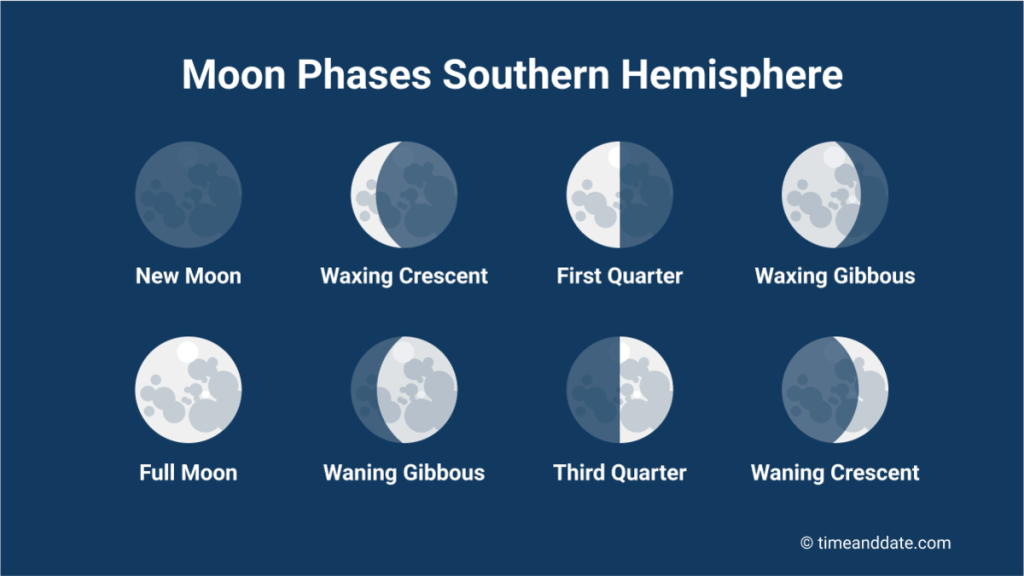
Moon Phases in Order
The eight Moon phases of a lunar month are divided into four primary and four intermediate (waxing and waning) Moon phases:
🌑New Moon
🌒Waxing Crescent Moon🌙
🌓First Quarter Moon
🌔Waxing Gibbous Moon
🌕Full Moon
🌖Waning Gibbous Moon
🌗Third Quarter Moon
🌘Waning Crescent Moon🌜
Primary Moon phases happen at a specific moment in time, while the time between these moments are the intermediate Moon phases. The lunar cycle lasts about 29.5 days, just under a calendar month.
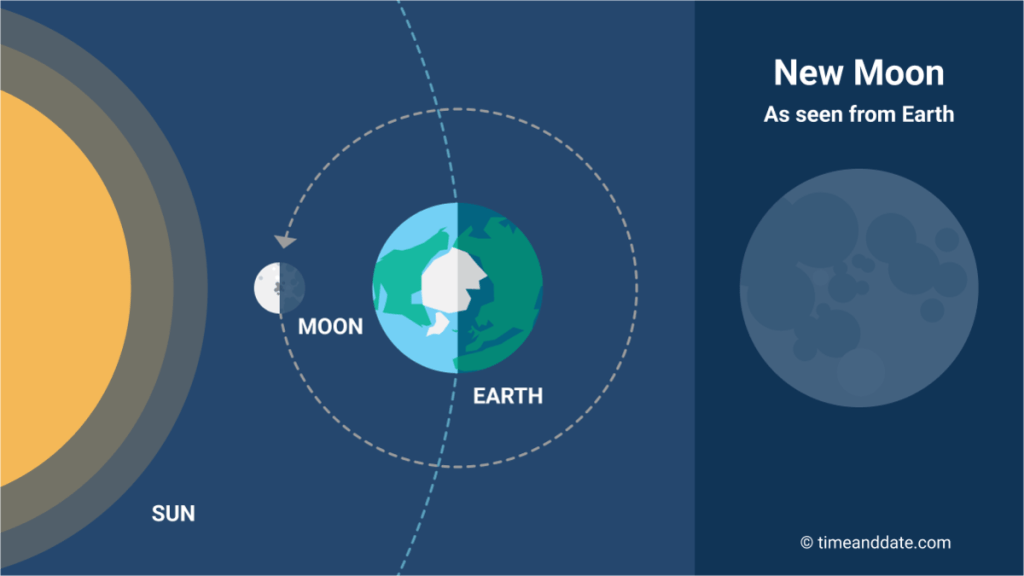
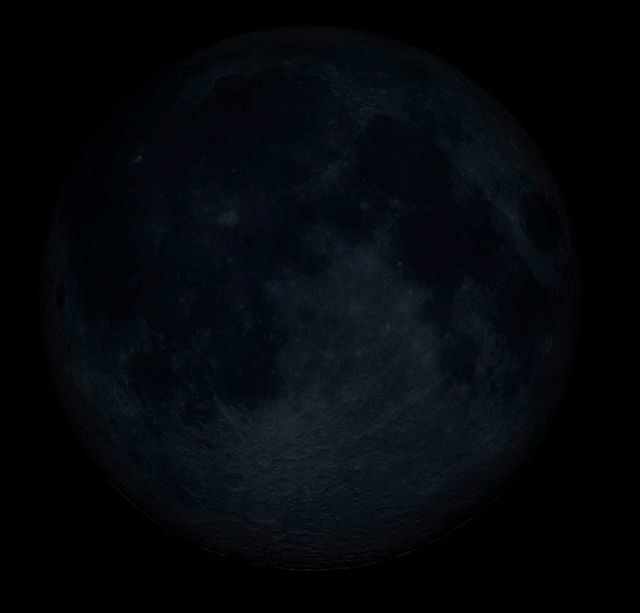
New Moon
Moon phase: primary
Moonrise: around sunrise | Moonset: around sunset
Illumination: 0% (approx)
Position in space: the Moon is between the Sun and Earth
If the Moon’s path crosses the plane of Earth’s orbit around the Sun (the ecliptic) while the Sun, Moon, and Earth are aligned at New Moon, a solar eclipse happens somewhere in the world.
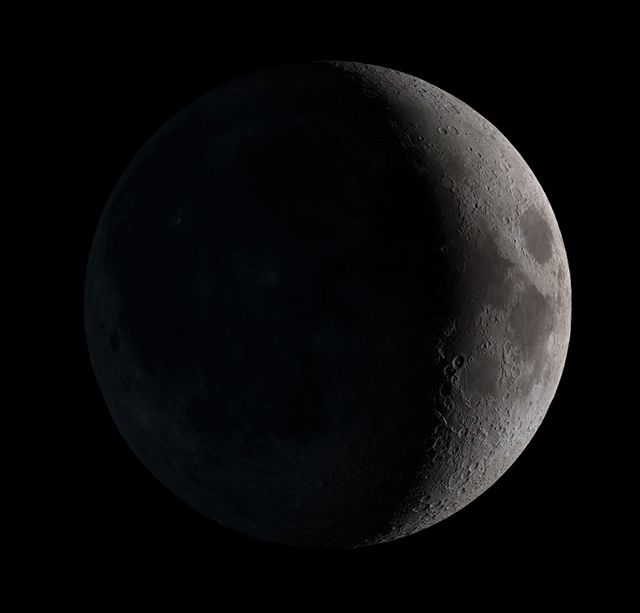
Waxing Crescent Moon
Moon phase: intermediate
Moonrise: morning | Moonset: afternoon
Illumination: 0% to 50% (approx)
Orientation: the lit part appears on the right side in the Northern Hemisphere,
and the left side in the Southern Hemisphere
Position in space: moving from New Moon to First Quarter Moon
The Crescent phases can be a good time to see Earthshine, when sunlight reflected from Earth gives the dark areas of the Moon a faint glow.
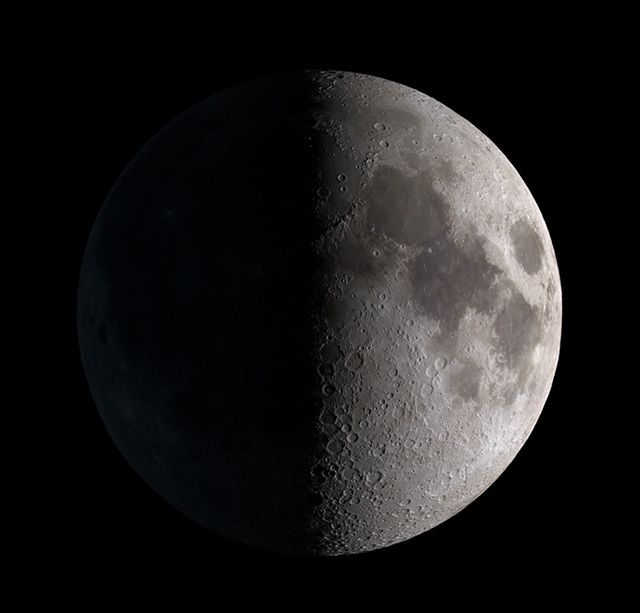
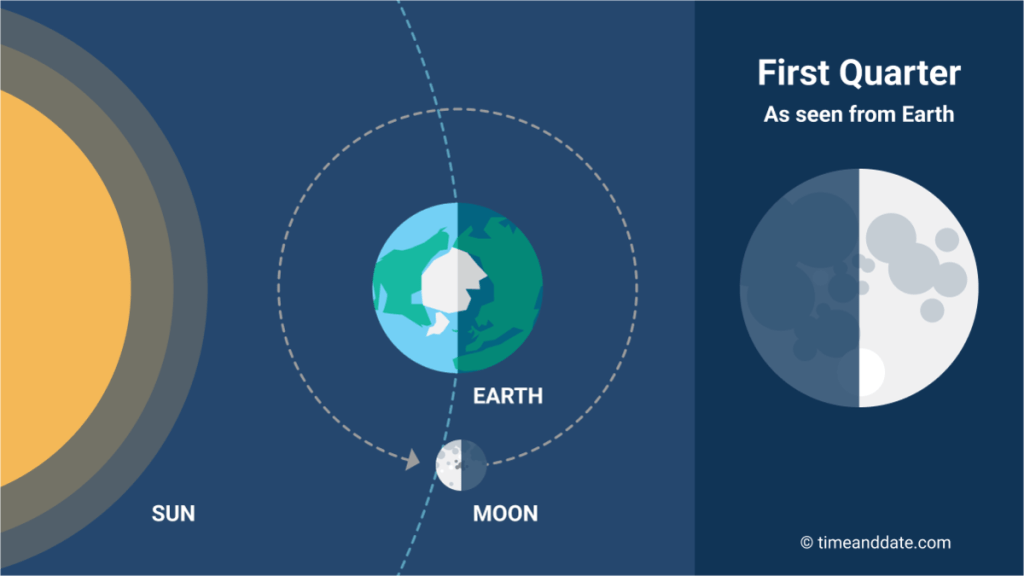
First Quarter Moon (Half Moon)
Moon phase: primary
Moonrise: around midday | Moonset: around midnight
Illumination: 50% (approx)
Orientation: the lit part appears on the right side in the Northern Hemisphere,
and the left side in the Southern Hemisphere
Position in space: the Moon has gone one quarter of the way around Earth
Look for the First Quarter Moon in the blue afternoon sky.
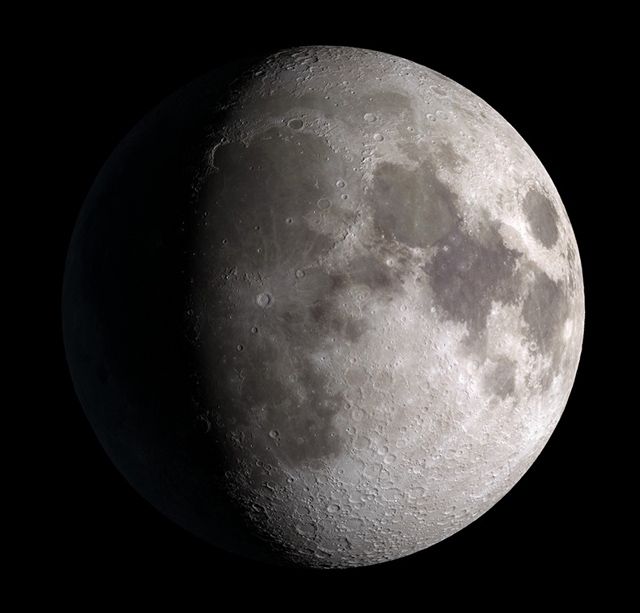
Waxing Gibbous Moon
Moon phase: intermediate
Moonrise: afternoon | Moonset: early morning
Illumination: 50% to 100% (approx)
Orientation: the lit part appears on the right side in the Northern Hemisphere,
and the left side in the Southern Hemisphere
Position in space: moving from First Quarter to Full Moon
A couple of days into the Waxing Gibbous Moon phase, you can see the Golden Handle.
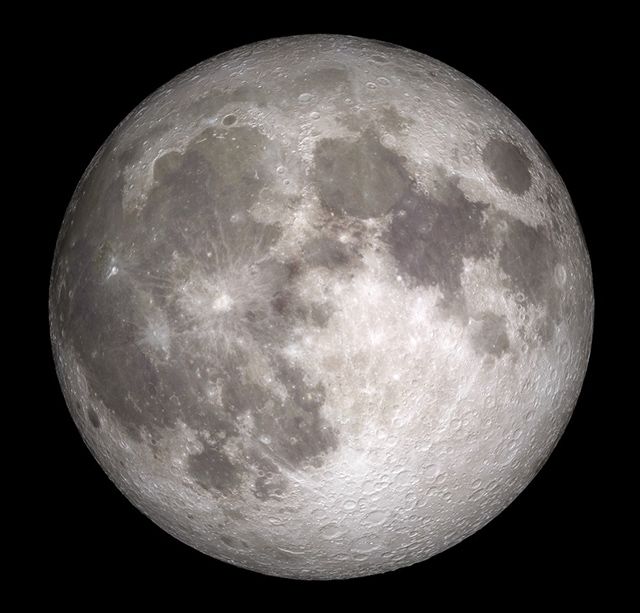
Full Moon
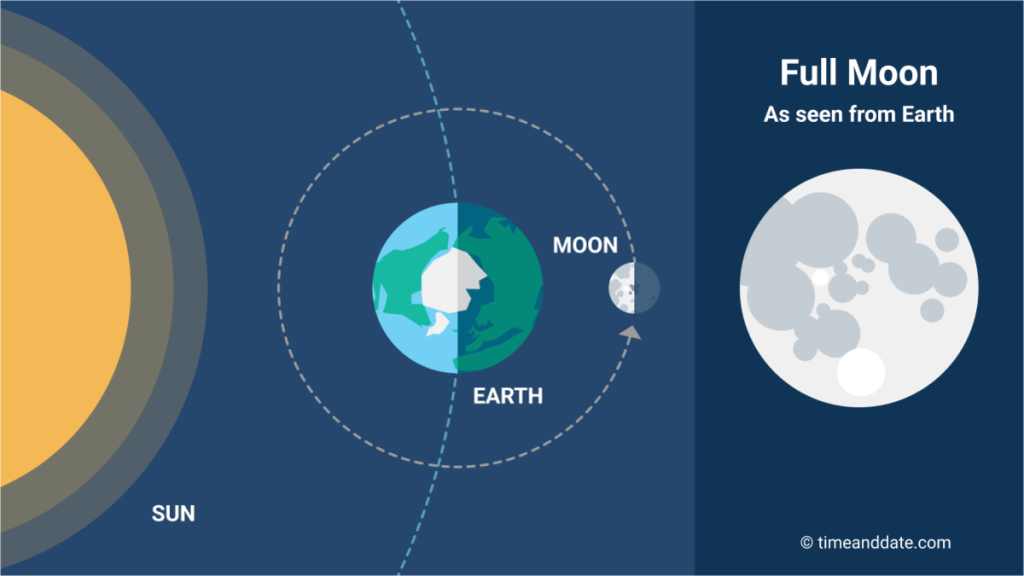
Moon phase: primary
Moonrise: around sunset | Moonset: around sunrise
Illumination: 100% (approx)
Position in space: the Moon and the Sun are on opposite sides of Earth
If the Moon’s path crosses the plane of Earth’s orbit around the Sun (the ecliptic) while the Sun, Earth, and Moon are aligned at Full Moon, a lunar eclipse happens on the night side of Earth.
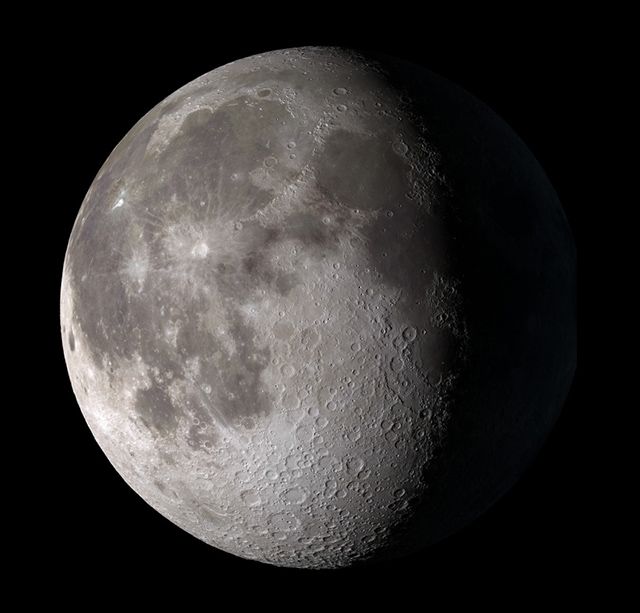
Waning Gibbous Moon
Moon phase: intermediate
Moonrise: evening | Moonset: morning
Illumination: 100% to 50% (approx)
Orientation: the lit part appears on the left side in the Northern Hemisphere,
and the right side in the Southern Hemisphere
Position in space: moving from Full Moon to Third Quarter Moon
The Moon can still look quite full a few days after Full Moon in the Waning Gibbous phase.
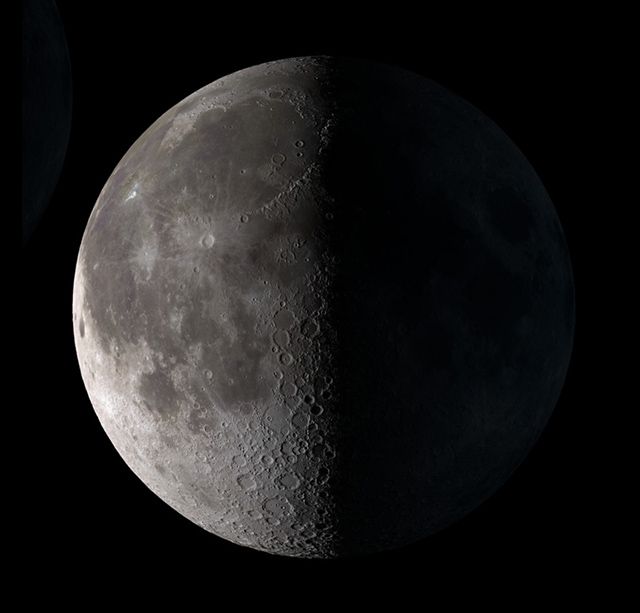
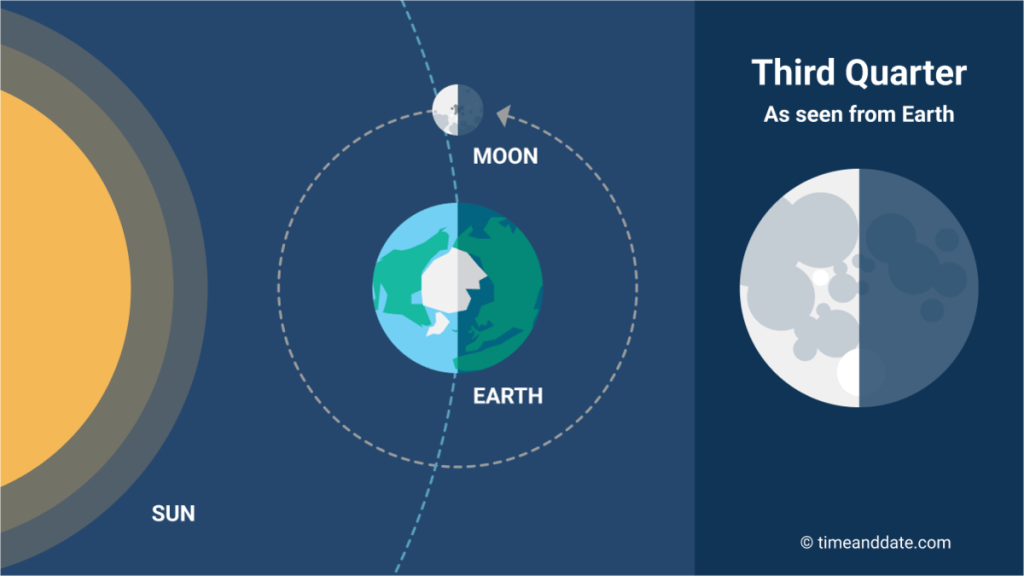
Third Quarter Moon (Half Moon)
Moon phase: primary
Moonrise: around midnight | Moonset: around midday
Illumination: 50% (approx)
Orientation: the lit part appears on the left side in the Northern Hemisphere,
and the right side in the Southern Hemisphere
Position in space: the Moon has gone three quarters of the way on its orbit around Earth
The Third Quarter Moon begins the last quarter of the lunar cycle.
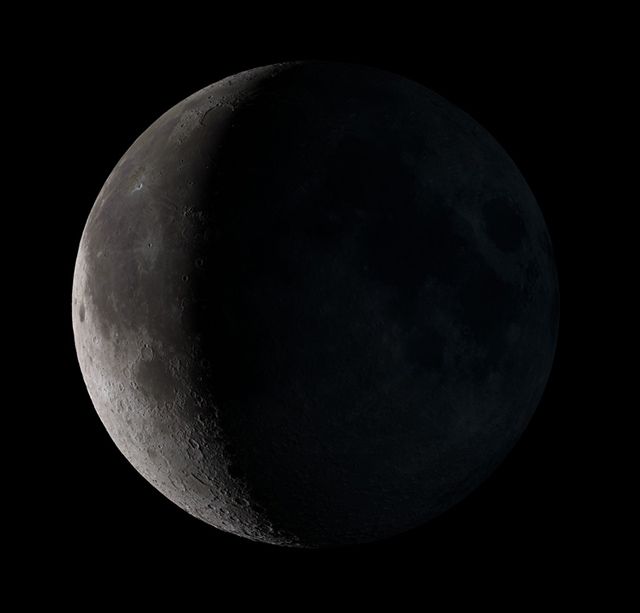
Waning Crescent Moon
Moon phase: intermediate
Moonrise: early morning | Moonset: afternoon
Illumination: 50% to 0% (approx)
Orientation: the lit part appears on the left side in the Northern Hemisphere,
and the right side in the Southern Hemisphere
Position in space: moving from Third Quarter to New Moon
The Crescent phases can be a good time to see Earthshine, when sunlight reflected from Earth gives the dark areas of the Moon a faint glow.
A lunar month starts at the invisible New Moon and lasts through all the Moon phases until the next New Moon.
What Is a Lunar Day?
29.5 days is also the length of a solar day on the Moon. For an observer standing on the Moon’s surface, this is the time from one sunrise to the next.
Why is a day on the Moon the same length as a lunar month on Earth? It’s because, like many moons in the solar system, the Moon has synchronous rotation: it takes the same time to spin once on its axis as it does to complete one orbit around the Earth.
Lunar Calendars
Calendars based solely on the Moon phases are known as lunar calendars, the ones based solely on the Sun are called solar calendars, and the ones that combine the Sun and the Moon are known as lunisolar calendars.
Lunar Holidays: Midsummer and More
The Islamic calendar is lunar, and also the historic Roman calendar sets the calendar year from the lunar month. The word month is even derived from the word Moon. Ancient cultures also named the Full Moons to track the seasons.
Our Western Gregorian calendar is a solar calendar, and follows the solar year and the Earth’s movements around the Sun. The Persian Solar Hijri calendar starts its new year on the exact time and date of the March equinox, making it one of the most precise calendars in the world.
The lunisolar calendar keeps track of the apparent movements of both the Moon and the Sun. The Chinese, Buddist, and Hindu calendars are lunisolar.
What Is a Lunation Number?
A lunation number is a number given to each lunar month and is usually found in Moon phase calendars and in almanacs.
The most commonly used lunation number is the Brown lunation number system, invented by Professor Ernest W. Brown in 1933. Brown started lunation 1 with the first New Moon of 1923, and this is why the lunation numbers listed before 1923 are negative, and we are currently in the 1200s today.
There are also other lunation cycles in use, such as Goldstine Lunation Number, Meeus’s Lunation Number, and the Islamic and Hebrew Lunation Number, which counts lunations in the Islamic and Hebrew calendar, respectively.
Affects the Tides
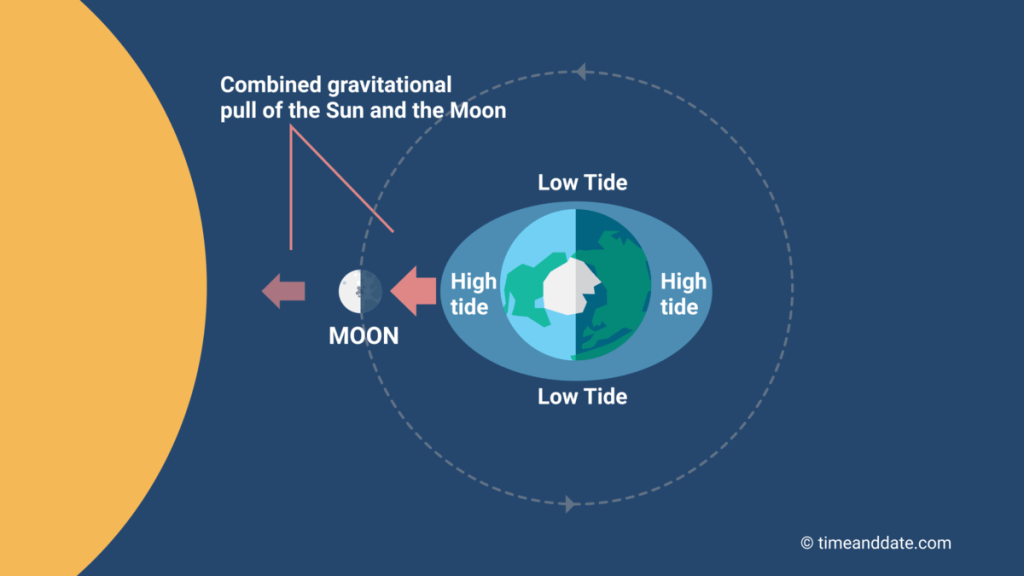
The ocean tides on Earth are mostly generated by the Moon’s gravitational pull. At the First and Third Quarter, the Moon and Sun pull in different directions, producing the smallest difference between high and low tide, known as neaps or neap tide.
The largest tidal range is around Full Moon and New Moon. During these Moon phases, the Moon and the Sun’s gravitational forces combine to pull the ocean’s water in the same direction. These tides are known as spring tides or king tides.
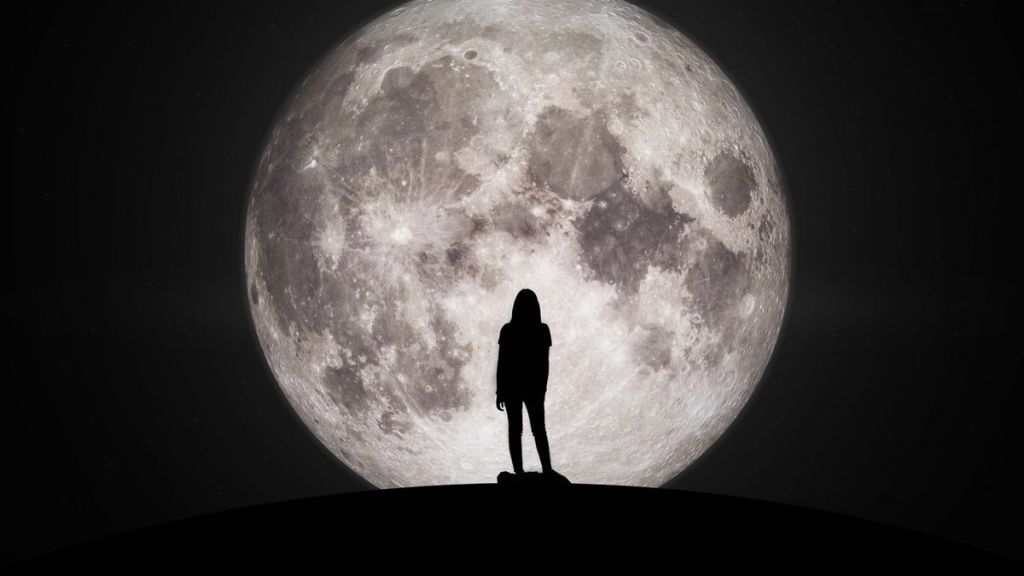
The power of the Moon is the stuff of legends. And science. So, how much does the Moon really affect us?
A Question of Lunacy
The Moon shines as brightly in our imaginations as it does in the night sky. Since ancient times, we’ve wondered about it, waxed poetic at it, howled at it, and blamed it for everything from werewolves to mood swings to madness.
Myths about the Moon are even baked into our language. Take the term lunatic—a Middle English word from the Latin lunaticus—which was coined out of the false belief that changes of the Moon caused outbursts of insanity.
But while some fantasies about lunar power are still widely believed, recent studies are starting to uncover compelling data about the Moon’s true influence on humans.
Exploding Myths and Asking Questions
Overall, there has been little hard evidence to prove that the Moon has a measurable effect on human physiology and behavior.
But recent research exploring the data behind some Moon myths has opened up fascinating new areas of study, suggesting we have more to learn about the lunar influence on our lives.
Bipolarity
Some researchers have found that the phase of the Moon seems to have a measurable effect on people with bipolar disorder. A 2018 study showed that patients who changed their body temperatures and sleep cycles to be in step with lunar phases were more likely to have a depressive-to-manic transition.
Menstruation
A 2016 study of 7.5 million cycles by Clue, a period tracking app, looked for a link between Moon phase and menses, but no connection was found. “We saw that period start dates fall randomly throughout the month, regardless of the lunar phase,” said Dr. Marija Vlajic Wheeler, lead scientist on the study. Another, smaller study showed some interesting nuances to this conclusion, however, finding some synchronicity that was later affected by women’s exposure to artificial light.
Murder
Looking at 6808 homicides committed in Finland between 1961 and 2014, researchers came to some surprising conclusions. They determined that there was indeed an association between Moon phases and homicides, but contrary to popular belief, there were fewer, not more, homicides on a Full Moon, especially in the earlier decades of their data. This was a relatively small study, so this is an area under further investigation.
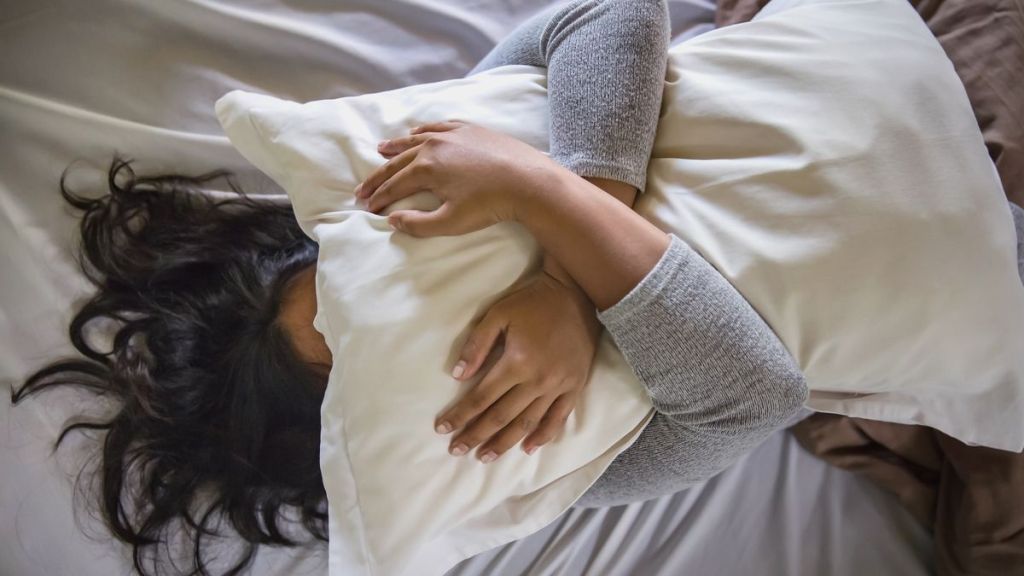
Sleep
Research also indicates that people get less deep sleep during a Full Moon, with more of a delay in entering into REM sleep. One study showed that people took an average of five minutes longer to fall asleep and slept 20 minutes less during a Full Moon.
Cardiovascular
There are signs that some people may experience a change in cardiovascular conditions driven by Moon phases. In a 2013 study published on the website of the US National Institute for Health, the authors speculated that the gravitational pull of the Moon may truly affect our cardiovascular system. And they noted that people’s physical efficiency increased during the new and Full Moon periods because of these lunar-driven systemic changes.
Niall McCrae, author of The Moon and Madness, summed it up this way: “We can be confident that the Moon does not have a noticeable impact on most people’s lives most of the time, but we cannot rule out the possibility of its role among various environmental factors that might affect our sleep, moods, and vitality.”
Madness and Misinformation
Outside the realm of science, there’s no shortage of mythology about the Moon’s power to drive us to distraction.
This idea has persisted throughout history, famously amplified by Shakespeare in Othello: “It is the very error of the Moon. She comes more nearer Earth than she was wont, and makes men mad”.
With this idea circulating, accused killers in 18th-century England could ask for a lighter sentence on the grounds of lunacy if the crime was committed under a Full Moon.
Still Among Us
A lot of rumors about lunar power are still circulating today.
Many of us believe it’s a bad idea to have an operation on a Full Moon. But a comprehensive study published in the Journal of Anesthesiology that looked at 18,000 surgeries at the Cleveland Clinic, focusing on a particular type of complication, found that the Moon’s phase had zero effect on the outcomes.
And as recently as 2019, the Times of India reported on a false local belief that “eating during a lunar eclipse is harmful for health, …because the eclipse leads to emission of strong ultraviolet rays, which impacts cooked food as it is prepared with water, …which turns the cooked food into poison.”
A Starring Role in Creation
Whether or not the Moon influences human behavior to any great extent, our natural satellite’s major role in enabling life on Earth is unquestioned.
Billions of years ago, the Moon was positioned much closer to the Earth, creating tides that were 1000 times higher than those we see today. These huge tides stripped minerals from coastal areas and added them to the oceans, which seems to have been an essential step in allowing life to evolve quickly in the water.
Driving the Seasons
Formed as a result of a giant impact some 4.5 billion years ago, the Moon’s gravitational pull helped tilt the Earth’s axis to its current 23.5°. The Moon helps maintain this angle, allowing a gradual progression through the seasons
Massive Force, Powerful Light, and Gentle Tugs
The gravitational pull of the Moon, although relatively weak on the Earth’s surface, is more powerful in the grand scheme of things than you may imagine.
In fact, Earth’s crust is pulled up several centimeters by the Moon’s force. Our oceans experience lifts measured in feet from its power. That immense pull results in Earth’s current length of day, stable seasons, and ocean tides.
And some life forms depend on lunar phases to initiate vital life cycles. Bright winter moonshine over the Arctic, for example, cues zooplankton to dive to escape predators, and rise again as the moonlight fades. There are also types of coral that base their spawning on the lunar cycle, while some sea turtle species such as Loggerheads seem to have nesting patterns that align with the Moon phases.
But while the Moon’s power is profound on the planetary scale, we humans are comparatively small organisms. So the lunar pull on our rhythms and systems, while intriguing, seems to be more on the order of a gentle tug. How much that level of force affects us will continue to be a fascinating area of research.
For more:
https://www.timeanddate.com/astronomy/moon/tides.html
https://www.timeanddate.com/astronomy/moon/moon-effect.html

 Phoenix Evolution